How to Build a Shopify Loyalty Program That Actually Drives Repeat Revenue
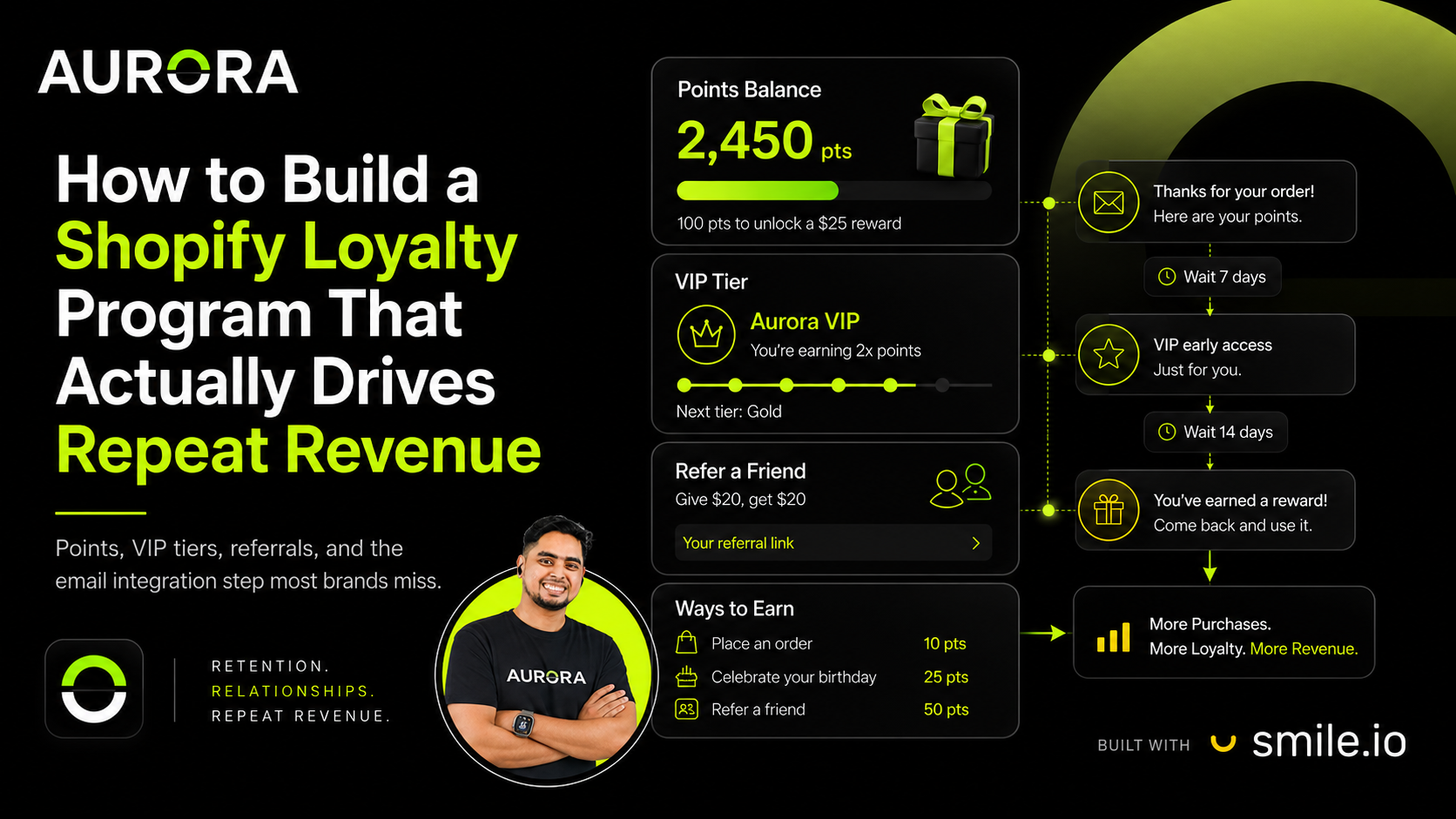
Most Shopify loyalty programs are technically live and commercially dead. Points accrue invisibly, rewards expire unredeemed, and the loyalty app never talks to the email engine that actually drives repeat purchases. This guide is the structure we use for clients — what a shopify loyalty program has to do to pull its weight, and the integration step that separates winners from the rest.
Why most Shopify loyalty programs underperform
It's almost never the points math. The pattern we see across hundreds of Shopify accounts is the same: a brand installs a loyalty app, switches on points, writes a quick FAQ, and moves on. The program runs in isolation from the email and SMS stack — so customers who earned points never get nudged to redeem, new members never get onboarded into the program, and tier upgrades happen silently in a dashboard nobody reads.
A mid-tier loyalty program wired into your lifecycle flows will out-earn a premium one running alone. Every time.
The earn-and-redeem structure that converts
Rewards only work if customers believe they're reachable. Calibrate your redemption ladder so a typical customer reaches their first reward inside their first order or two — that's the moment a program goes from theoretical to real in someone's head.
Then reward the behaviors you actually want more of, not just raw spend:
- Account creation — captures the email and starts the lifecycle relationship before the first purchase
- First and repeat orders — the core earning event
- Birthday engagement — a built-in reason to re-surface the program once a year
- Reviews and referrals — high-value behaviors most brands underprice
The mistake we see most often: programs that reward only spending. Spending is a lagging indicator. Reward the leading behaviors that produce spending.
VIP tiers that drive behavior, not just decorate
Tiers without a deadline are a static discount table. Three design choices separate tiers that change behavior from tiers that decorate the program:
- Visible ladder. Customers should see the next tier from anywhere in the program — what it unlocks and how close they are.
- Annual reset. VIP status has to be re-earned (e.g. annually) so customers stay active year-round, not just during launches.
- Margin-aware perks. Tier benefits should reward loyalty without eroding profitability — free shipping thresholds, early access, exclusive bundles beat blanket % off.
And the moment a customer levels up, tell them — a real email, not a quiet badge change. The level-up email is one of the highest-engagement messages in a loyalty program when it exists.
Two-sided referrals: your cheapest acquisition channel
Your happiest customers are your cheapest acquisition — if you let them be. Three rules:
- Reward both sides. One-sided referral offers convert poorly. Give the friend a reason to buy and the referrer a reason to share.
- Surface the offer at peak satisfaction. The order confirmation page is the highest-converting referral surface in DTC. Use it.
- Prompt guests too. Don't gate the referral CTA behind account creation — even non-account-holders should see the prompt post-purchase.
On-site visibility: where invisible programs die
A program nobody can see is a program nobody uses. The Shopify storefronts where loyalty actually works treat the program as a first-class part of the shopping experience, not an afterthought in the footer:
- Show points-per-product on PDPs while shoppers are still browsing
- Surface points balance in the header and account page — no hunting
- Prompt new visitors to join with the program's clearest value prop, not a generic "sign up for emails"
- Translate points into real money at every point of mention — "500 points = $5 off" beats "500 points"
The Klaviyo integration most brands miss
This is where the program moves from "loyalty app" to retention engine. Connect your loyalty platform to Klaviyo and sync the behavioral signals that matter — points balance, VIP tier, and referral activity — into your email and SMS engine. With that data flowing, build the lifecycle flows that fire on loyalty behavior:
- Loyalty welcome series — onboards new members and teaches them how to earn
- Redemption reminder — nudges customers sitting on enough points to claim a reward before they forget the program exists
- Tier-upgrade celebration — tells customers the moment they level up and what they just unlocked
- Referral reminder — re-surfaces the referral offer to your most engaged segment
- At-risk redemption nudge — for customers about to lose points or tier status
If you want the step-by-step for the Klaviyo side of this, our Klaviyo + Smile.io integration guide walks through the exact connector setup, event mapping, and flow architecture.
How to know your program is actually working
Forget vanity points-issued metrics. The four numbers that actually matter:
- Repeat purchase rate of program members vs non-members
- LTV lift by tier — Gold customers should clearly outperform Silver
- Redemption rate — points earned that actually get spent (low redemption = invisible program)
- Loyalty-attributed email revenue — flows triggered by loyalty events, tracked in Klaviyo
If you'd rather run your existing setup against a structured 17-point audit, we put one together: the Connected Loyalty Program Checklist — same framework, scored live, free.
We've built this exact system
We recently designed and launched a connected loyalty program for a UK accessories brand on Shopify — earn-and-redeem structure, three-tier VIP, two-sided referrals, and the full Klaviyo lifecycle integration that turns loyalty data into automated revenue. Read the case study →
- Klaviyo Partner
- Smile.io Partner
- Shopify Partner
- 700+ brands served
Frequently Asked Questions
What is a Shopify loyalty program?
A Shopify loyalty program is a structured rewards system — usually points, VIP tiers, and referrals — that runs on your Shopify store via apps like Smile.io or LoyaltyLion. The program tracks behavior (purchases, account signup, referrals, birthdays) and rewards customers with points, perks, or status to drive repeat purchases and lift customer lifetime value.
Which is the best loyalty app for Shopify?
Smile.io is the strongest default for most Shopify brands — points, VIP tiers, and referrals in one stack, with a mature Klaviyo integration. LoyaltyLion offers deeper enterprise customization for larger accounts. The bigger factor is rarely the app itself; it's whether you wire the loyalty data into your email and SMS engine. A mid-tier app integrated with Klaviyo outperforms a premium one running in isolation.
Do Shopify loyalty programs actually drive repeat revenue?
Yes, when designed and integrated correctly. A loyalty program that visibly rewards first-order, repeat order, signup, and referral behavior — and triggers automated Klaviyo flows on points balance and tier changes — lifts repeat purchase rate and LTV measurably. A program that's installed but disconnected from email almost never moves the needle.
How long does it take to launch a Shopify loyalty program?
A complete program — strategy, points and tier configuration, on-site surfacing, referral setup, and the Klaviyo integration with lifecycle flows — typically takes 2–3 weeks. The app install is a day; the design and integration work is what produces the result.
Want this built for your store?
We design and launch connected loyalty programs for Shopify brands — Smile.io configuration, VIP and referral design, and the Klaviyo integration that makes the program run automatically.
Ready to build a loyalty program that actually drives repeat revenue? Talk to AURORA →