7 Klaviyo Flows Ecommerce Brands Should Fix Before BFCM
Most BFCM flow problems are not caused by missing automations.
They happen because flows that work perfectly well during normal trading are left unchanged while everything around them changes.
The offer gets stronger. Campaign frequency increases. SMS becomes more active. Site traffic spikes. More people browse, add to cart and enter checkout. Existing customers come back. New subscribers arrive through BFCM forms.
Your Klaviyo flows keep running through all of it.
That is why a good Klaviyo BFCM strategy should not begin with 'Which flows do we need to build?' A better question is: Which existing flows are most likely to create offer conflicts, poor timing, duplicate messaging or missed revenue once BFCM starts?
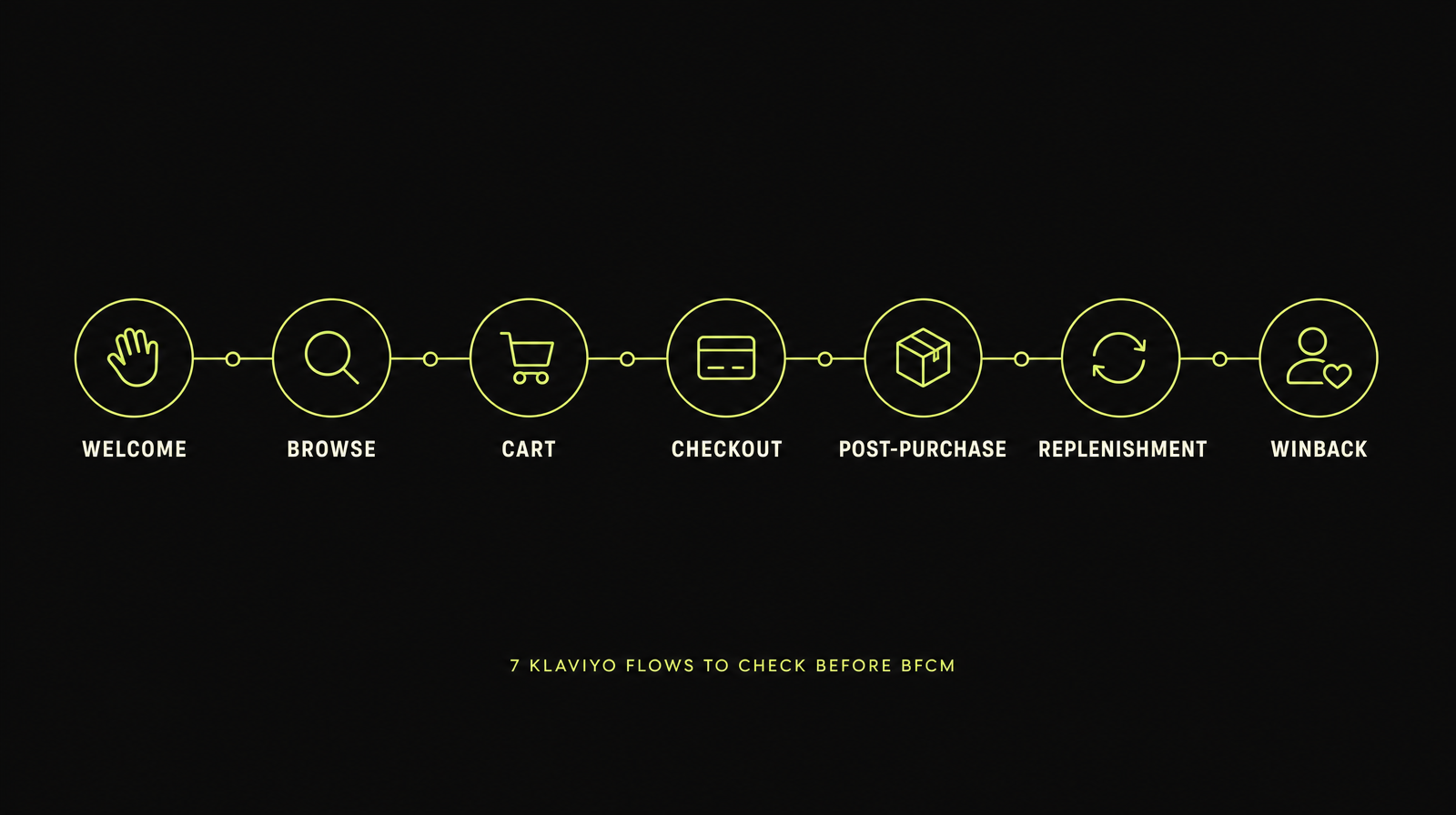
For most ecommerce brands, I would start with these seven:
Klaviyo's current BFCM guidance recommends reviewing automated messaging so it complements holiday promotions rather than contradicting them. It also recommends considering how abandonment timing, offers and promotional messaging behave during peak promotional periods.
Source: Klaviyo — When to send Black Friday emails
The goal is not to redesign every automation for Black Friday. It is to make sure the customer sees one coherent journey.
If you are still mapping the season itself — calendar, offer architecture and audiences — start with our BFCM campaign strategy guide, then come back here for the automation layer.
Why BFCM exposes flow problems faster
A normal week gives your automation room to breathe. BFCM compresses everything.
A customer might subscribe in the morning, browse three products, add one to cart, receive your Black Friday campaign, get an SMS, return to checkout, purchase, and receive another scheduled campaign later that evening — all within the same day.
That means a small problem in your flow logic becomes much more visible.
A Welcome Flow offering 10% off may not be a major issue in September. During a 25% BFCM sitewide sale, it can immediately look outdated.
An abandoned-checkout delay that normally makes sense may feel too slow during a short promotional window.
A customer who purchases in the morning should not continue receiving acquisition urgency in the afternoon simply because they qualified for a message before placing the order.
BFCM does not necessarily require more automation. It requires better coordination.
The three checks for every BFCM Klaviyo flow
Before reviewing individual flows, use the same three questions for all of them.
- Offer
- Does this automation show the right promotion?
- Timing
- Does the normal delay still make sense during BFCM?
- Eligibility
- Should this person still receive the message?
- discount amount
- coupon code
- free shipping
- bundle messaging
- gifts
- loyalty rewards
- countdown language
- expiration dates
- purchase window
- customer intent
- campaign cadence
- SMS overlap
- flow-to-flow overlap
- Have they already purchased?
- Did they use the BFCM offer?
- Are they receiving another flow?
- Did they just get an SMS?
- Are they already inside a post-purchase journey?
- Are they still eligible for the incentive shown?
Klaviyo Academy's current BFCM sending guidance also recommends excluding people who have purchased within the last day from ongoing Black Friday sales campaigns to avoid over-messaging, reinforcing the same customer-state principle.
Source: Klaviyo Academy — BFCM daily sending guide
1. Welcome Flow
Your Welcome Flow may be one of the first places BFCM creates a conflict.
During peak season, list growth often increases because brands run early-access forms, VIP signup campaigns, stronger signup incentives and holiday landing pages. That means more people are entering the flow at the exact time your sitewide promotion is changing.
Imagine your normal Welcome Flow says: "Get 10% off your first order." Then BFCM launches at 25% off sitewide.
The Welcome Flow is now offering a worse deal, creating unnecessary confusion, or making the customer wonder whether the discounts stack. None of those help conversion.
Common problem: A normal Welcome incentive can offer a worse deal than the live BFCM promotion, or make subscribers wonder whether the discounts stack.
What to review:
- standard Welcome incentive
- BFCM site offer
- whether codes can stack
- signup source
- form-specific messaging
- timing of first email
- flow branches
- BFCM exclusions
- post-purchase exit logic
Practitioner check: If I subscribed to this form today and immediately visited the website, would the Welcome email make the offer clearer or more confusing?
If you are running a specific BFCM early-access form, those subscribers may deserve different messaging from someone joining through the normal newsletter form. You might temporarily replace the normal discount, remove the incentive, create a BFCM-specific branch, route early-access subscribers differently, or focus the Welcome message on product discovery rather than price.
2. Browse Abandonment Flow
Browse Abandonment becomes especially interesting during BFCM because the customer may have strong intent but still be comparing. They may browse your site, check competitors, wait for another sale, compare shipping or look for reviews before returning later.
The flow waits too long. If someone viewed a product Friday morning and your Browse Abandonment email arrives Saturday night, the buying window may already have moved on.
The opposite problem also exists. Sending an email almost immediately after a single product view can feel aggressive.
Common problem: The delay is either too long for a compressed buying window, or so short that a single product view triggers an aggressive message.
What to review:
- browse threshold
- delay
- number of messages
- product personalization
- BFCM offer language
- purchase exclusions
- Add-to-Cart overlap
- campaign frequency
- Smart Sending or frequency rules where relevant
Practitioner check: Is this message adding product relevance, or simply repeating the same sale announcement the customer already received?
The email does not necessarily need to repeat the sale. If the customer already knows the promotion, the more useful message may be bringing the exact product they viewed back into focus. During BFCM, campaigns can provide urgency while Browse Abandonment provides relevance.
3. Add-to-Cart Flow
An Add-to-Cart Flow catches stronger intent than Browse Abandonment. The customer did more than look; they chose something. That makes this one of the flows worth checking carefully before BFCM.
The flow contains outdated urgency or an old incentive.
For example: "Complete your order today and save 10%" while the BFCM campaign already gives everyone 25%, or "Your offer ends tonight" when the actual sale runs through Monday.
Common problem: Outdated urgency or an old incentive survives from normal trading and contradicts the real BFCM promotion.
What to review:
- current incentive
- code behavior
- timing
- campaign overlap
- checkout flow overlap
- purchase filters
- product block accuracy
- SMS logic
- expiration language
Practitioner check: Does the flow's urgency match the real promotion, or did an old timer or incentive survive from normal trading?
Your Add-to-Cart Flow should support the shopping journey. It should not create a second version of the promotion. If the promotion ends Monday, say it ends Monday. If stock is genuinely limited, use that. Avoid manufactured urgency that contradicts the real offer.
4. Abandoned Checkout Flow
If I could only review one abandonment flow before BFCM, this would be high on the list. The customer is close to purchase, and during peak periods even small changes in timing or messaging can matter.
A checkout email does not exist in isolation.
During BFCM, the same customer may also receive your launch campaign, an SMS, Browse Abandonment, Back in Stock and a Cyber Monday campaign within a relatively short window. That is where frequency can become messy.
Common problem: Checkout reminders collide with campaigns, SMS and other abandonment flows inside the same short window.
What to review:
- first delay
- subsequent delays
- number of messages
- exit conditions
- coupon code
- BFCM language
- SMS timing
- campaign overlap
- product block
- shipping messaging
- urgency
Practitioner check: If this customer receives the checkout reminder plus a campaign and SMS in the same few hours, does the sequence still feel intentional?
A shorter promotion can justify faster follow-up because the purchase window is compressed, but faster is not automatically better. Review what normally converts and make a deliberate decision. If the sitewide BFCM discount is already strong, you may not need an additional abandonment discount at all.
For the broader build order behind these automations, see the 7 Klaviyo flows every Shopify store needs.
5. Post-Purchase Flow
Post-Purchase is one of the easiest places to accidentally ruin the customer experience during BFCM. The customer has already done what you wanted. They purchased. Your messaging should notice that.
Someone buys during your Black Friday promotion at 10 AM. At 3 PM they receive "LAST CHANCE: 25% OFF EVERYTHING." At 6 PM they receive another acquisition message.
That does not feel personalized. It feels like the automation and campaigns have no idea the customer bought.
Common problem: Acquisition urgency keeps reaching customers who already purchased during the promotion.
What to review:
- campaign exclusions for recent purchasers
- post-purchase timing
- promotional blocks
- cross-sell timing
- second-order offers
- loyalty messaging
- review timing
- shipping expectations
- product education
- SMS overlap
Practitioner check: What should change immediately after purchase: eligibility, message purpose, or both?
BFCM may create longer fulfillment times, so operational communication becomes part of retention. Depending on the product, the customer may benefit more from onboarding, usage guidance, care instructions or reassurance before another offer. BFCM acquisition becomes more valuable when the relationship continues after the discount.
6. Replenishment Flow
Replenishment is easy to overlook because it may have nothing visually "Black Friday" about it. But for consumable or repeat-purchase products, it can be highly relevant.
The normal replenishment schedule keeps running without checking whether the customer just stocked up during BFCM.
If customers buy larger quantities during the promotion, their normal replenishment cycle may change.
Common problem: The normal reorder schedule keeps running even though a BFCM stock-up changed the customer's actual usage cycle.
What to review:
- last purchase date
- product purchased
- normal replenishment interval
- BFCM purchase behavior
- recent order exclusions
- quantity purchased
- subscription status
- promotional language
Practitioner check: Did the BFCM purchase reset the replenishment clock, change quantity, or move the customer into subscription?
A customer buying three units may not need the same reminder as someone buying one. Replenishment works best when it reflects actual usage and purchase patterns rather than a generic "time to reorder" schedule. BFCM gives you new purchase data; use it.
7. Winback Flow
Winback and BFCM can work well together. A strong holiday offer may give an old customer a reason to return, but the flow needs to be coordinated with your campaigns.
A lapsed customer receives "We miss you — here's 15% off," then an hour later receives "BLACK FRIDAY: 25% OFF." The winback incentive immediately looks pointless.
Or both codes work, creating an unnecessary margin problem.
Common problem: The winback incentive is weaker than the public sale, or both codes work and create a margin problem.
What to review:
- winback incentive
- BFCM campaign eligibility
- flow timing
- recent purchase filters
- overlap with lapsed-customer campaigns
- discount stacking
- exit logic
Practitioner check: Is the Winback Flow adding context from the previous customer relationship, or just offering a weaker discount than the public sale?
You may decide that the public promotion replaces the normal winback offer, the flow pauses temporarily, the flow switches to BFCM messaging, or lapsed customers receive a dedicated BFCM campaign instead. The mistake is letting both systems run independently without checking.
How campaigns and flows should work together during BFCM
The cleanest BFCM accounts do not treat campaigns and flows as two separate marketing programs.
The customer does not care which internal Klaviyo tab created the message. They only experience the brand.
That means the campaign calendar should be planned alongside automation.
Consider this customer journey:
- 9:00 AM — Receives Black Friday launch email.
- 10:30 AM — Browses a product.
- 11:00 AM — Adds it to cart.
- 12:30 PM — Leaves checkout.
- 2:00 PM — Receives scheduled SMS.
- 3:00 PM — Completes purchase.
What should happen next? The answer should not be: everything that was scheduled before the purchase keeps going. The purchase should change eligibility. The customer journey should move with the customer.
If a profile is subscribed to both email and SMS, decide which channel carries the main explanation, which channel carries urgency, whether frequency rules apply, whether an SMS is still needed after an email click, and whether a flow SMS and campaign SMS might collide.
More channels do not automatically create a better experience. Better coordination does.
Coordinating flows, campaigns and SMS across a peak season is implementation work, not just planning. See how we work
Pre-BFCM Klaviyo flow QA checklist
Before BFCM launches, review every high-impact flow against this checklist.
Offer
- Is the discount correct?
- Is the code valid?
- Can it stack?
- Does it match the website?
- Does it conflict with loyalty?
- Is the expiration accurate?
- Is the BFCM offer stronger than the normal flow incentive?
Timing
- Does the first delay still make sense?
- Should abandonment move faster?
- Are multiple messages too close together?
- Does SMS overlap?
- Does campaign frequency change the ideal timing?
Eligibility
- Does purchasing remove the customer?
- Are recent purchasers excluded?
- Could the customer enter multiple overlapping flows?
- Is the message still relevant after a BFCM purchase?
- Are VIPs or existing customers treated differently?
Content
- Are subject lines current?
- Are product blocks working?
- Are links correct?
- Is mobile rendering clean?
- Are old promotional banners still present?
- Is urgency truthful?
- Are shipping terms accurate?
Technical QA
- Trigger
- Flow filters
- Conditional splits
- Profile properties
- Coupon behavior
- UTM tracking
- Dynamic content
- SMS consent
- Suppression rules
- Test profiles
- Live preview
Not sure whether your account is ready for BFCM? A structured Klaviyo audit can identify flow conflicts, weak timing, broken logic and missing revenue opportunities before campaign volume increases. Get a Klaviyo audit
Which flows should you prioritize if time is limited?
If you cannot review everything, prioritize based on two things: traffic volume and purchase intent.
For many ecommerce brands, that means starting with:
If time is limited, start here
- Abandoned Checkout
- Welcome
- Add to Cart
- Browse Abandonment
- Post-Purchase
Then review Replenishment and Winback based on how important those journeys are to your business model. A consumables brand may move Replenishment much higher. A brand with a large lapsed customer base may prioritize Winback. The right order comes from the account, not from a generic template.
For more implementation patterns, see our ecommerce email automation examples and recent case studies.
BFCM Klaviyo flow FAQ
Frequently Asked Questions
Should I pause my Klaviyo flows during BFCM?
Usually, you should not automatically pause every flow. Many flows become more valuable during BFCM because traffic and purchase intent increase. Instead, review their offer, timing and eligibility so they work alongside promotional campaigns. Some individual flows or branches may need temporary changes depending on the promotion.
Should I change my Welcome Flow for Black Friday?
If your normal Welcome incentive conflicts with the BFCM offer, yes, it should be reviewed. You may need to change the offer, adjust branch logic or temporarily use BFCM-specific messaging. The important thing is that the Welcome experience does not present a worse or contradictory promotion.
Should abandoned cart emails send faster during BFCM?
Sometimes. Promotional shopping can move faster during BFCM, so shorter delays may make sense. But your own purchase cycle and historical performance should still guide the final timing. Do not shorten delays simply because it is Black Friday.
Should I add another discount to my abandoned checkout flow during BFCM?
Not automatically. If customers already have access to a strong BFCM discount, adding another incentive may reduce margin without adding much conversion value. First consider whether reminder, urgency and product relevance are enough.
Should recent purchasers still receive BFCM campaigns?
Often they should be treated differently. A recent buyer may need post-purchase communication, complementary products, loyalty or product education rather than another acquisition message telling them to buy what they have already purchased.
Do Klaviyo flows need special BFCM designs?
Not necessarily. The priority is strategic consistency. If the existing design is strong, you may only need to update the offer, product messaging, subject line, urgency, banner, timing or logic. Do not redesign a flow purely because it is Black Friday.
Which Klaviyo flow is most important for BFCM?
There is no universal answer, but Abandoned Checkout, Welcome, Add to Cart and Browse Abandonment are usually high priorities because BFCM increases both traffic and purchase intent. The right priority depends on your account and customer journey.
Final takeaway
The biggest BFCM flow mistake is assuming that because an automation works today, it will still make sense once the promotion begins.
Your normal flows were built around normal conditions. BFCM changes the offer, customer urgency, campaign frequency, site traffic, purchase behavior and channel overlap.
So the flows need to be checked against those new conditions.
The simplest framework is: Offer → Timing → Eligibility.
If those three are right, your automations are much more likely to support the BFCM campaign instead of competing with it.
If you are heading into BFCM and are not sure which Klaviyo flows are underperforming, conflicting with campaigns or missing key logic, start with a structured Klaviyo audit before adding more messages to the account. Start with an audit
Sources & methodology
- Klaviyo — When to send Black Friday emails — Current 2026 BFCM guidance; used for statements about peak-period planning and reviewing abandonment timing.
- Klaviyo Academy — BFCM daily sending guide — Used to support the recommendation to exclude recent purchasers from ongoing promotional campaigns to avoid over-messaging.
- Klaviyo Academy — Plan an omnichannel marketing strategy for BFCM — Supporting source for segmentation, deliverability and coordinated channel planning.
- Editorial note — The operational recommendations in this article are AURORA practitioner guidance. They should not be presented as universal Klaviyo requirements unless the linked source explicitly says so.