How to Audit a Klaviyo Account in 2026 (A Practitioner's Guide)
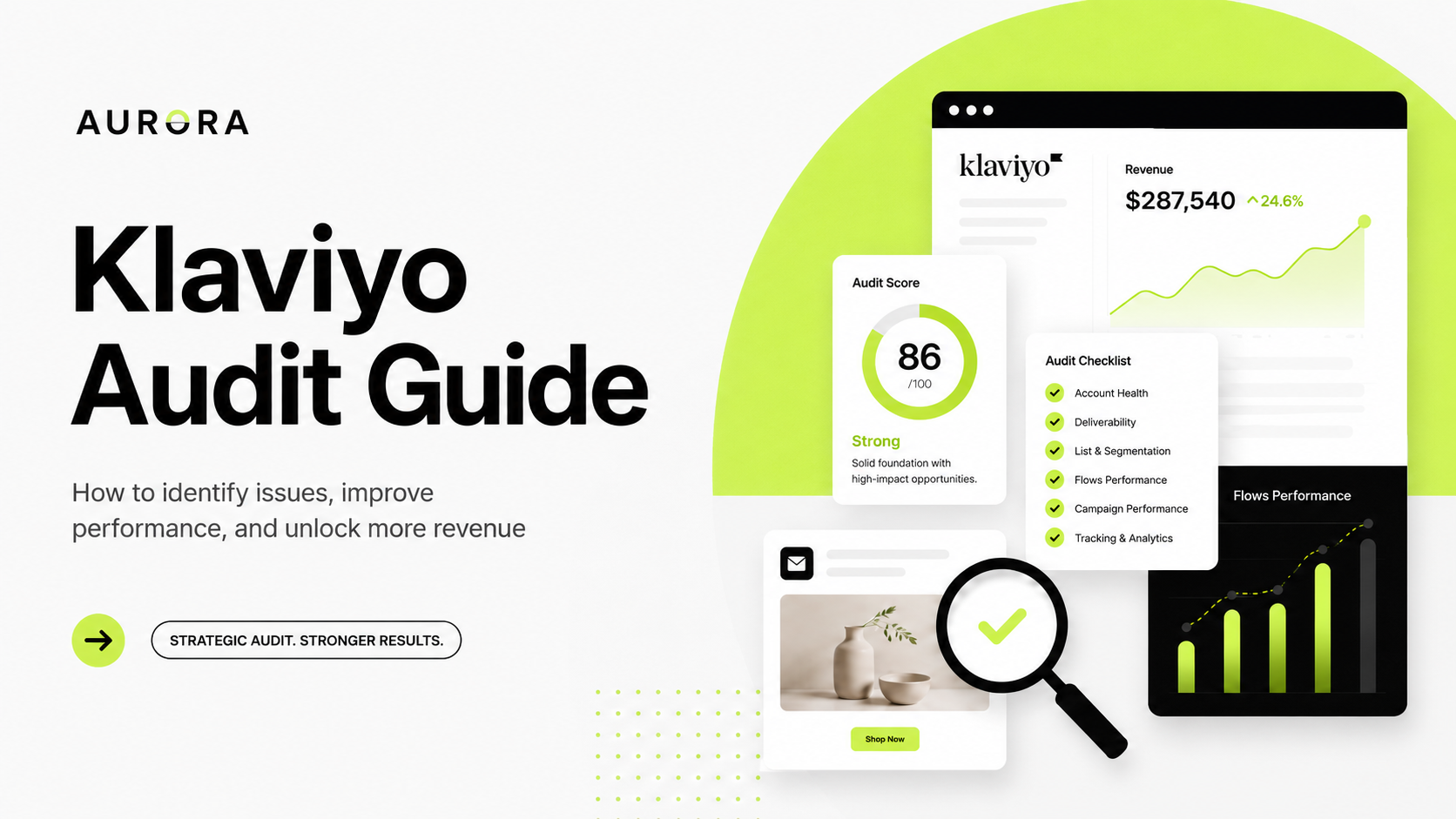
I've audited over 400 Klaviyo accounts in the last few years. Here's the pattern almost every store has in common: 5–7 flows are technically live, but only 2 actually drive revenue. The rest sit there generating opens and zero attribution.
This guide is the same Klaviyo audit checklist I run when a Shopify brand hires me. It takes about 30 minutes if you know what you're looking for. And if you don't yet, the 8 sections below will tell you exactly what to check, in what order, and what "good" looks like.
I'm Mohammad Shariful Alam. I run AURORA — a Klaviyo Partner agency working with DTC brands across the UK, US, EU, and Australia. I'm also a Shopify, Omnisend, and Smile.io partner, which means I see what works across platforms, not just within one.
- Klaviyo Partner
- Shopify Partner
- Omnisend Partner
- Smile.io Partner
- 5.0★ Verified Clients
- 700+ Brands Audited
You can run this audit on any Klaviyo account. If you don't have one yet, create it first. Create free Klaviyo account →
What a Klaviyo audit actually checks
Most "audits" you'll see online are surface-level: open rates, click rates, list size. That's not an audit. That's reading the dashboard.
A real Klaviyo audit looks at four things: deliverability and account health, flow architecture, campaign quality, and integration integrity. Most of the issues I find aren't "your subject lines need work." They're structural — broken triggers, missing exclusions, wrong filters, integrations that stopped syncing six months ago and nobody noticed.
1. Account and deliverability check
Start here, because if your deliverability is broken, nothing else matters. Pretty emails don't help if they're going to spam. Open Klaviyo → Account → Deliverability and check:
- Domain authentication — SPF, DKIM, and DMARC on a dedicated sending domain.
- Sender reputation score — anything below 95 needs attention; below 85 is a red alert.
- Bounce rate trend — spikes usually mean a list-quality issue.
- Complaint rate — should be under 0.1%.
2. List and segment audit
Pull up your master list count, then look at three things: active vs. unengaged contacts, the logic behind your top 5 segments, and suppression list health. The audit question to ask: if I sent a campaign tomorrow, who exactly would receive it, and why those people?
3. Flow audit (the big one)
This is where most revenue is left on the table. For each of the flows below, check whether it exists, whether it's live, and whether the structure makes sense. (For the full architecture of each, see our guide to the 7 essential Klaviyo flows.)
- Welcome series — triggered on signup, exclusions for existing customers, 4–6 emails over 7–14 days.
- Abandoned cart — Started Checkout trigger, 3+ emails, SMS layered in, placed-order exclusion.
- Browse abandonment — often missing entirely; 1–2 emails on Viewed Product.
- Post-purchase — order confirmation, shipping, product education, review request, cross-sell or replenishment.
- Win-back — incentive on email 2, not email 1.
- Sunset — protects sender reputation; most accounts skip this.
- Birthday or VIP — optional but high-converting if your product fits.
Want the architecture for each of these flows? Read the 7 Klaviyo flows guide →
“They are absolutely outstanding to work with. Went above and beyond to deliver a fully bespoke Klaviyo setup tailored to my business. Made the whole process seamless and stress-free.”
4. Campaign audit
Pull the last 90 days of campaigns and look at send frequency, open rate trend, click-to-open rate, and revenue per recipient (RPR). RPR below $0.10 is a problem; above $0.50 is excellent. The fix isn't always "send better emails." Often it's "send the same emails to the right segment."
5. Integration check
Klaviyo is only as good as what feeds it. Confirm Shopify, your loyalty platform (Smile.io, Yotpo), reviews, and subscriptions are all syncing in real time. A broken integration silently kills 10–30% of personalization.
6. Pop-up and signup form audit
- Conversion rate of your main pop-up — 3–5% typical, 8%+ excellent.
- Mobile vs. desktop performance — most stores have mobile breaking.
- Targeting — don't show the welcome offer to existing customers.
- SMS consent collection with proper compliance language.
7. The 30-minute self-audit
- Check sender reputation in Klaviyo → Deliverability.
- List your live flows. Are at least 5 of the core 7 present?
- What % of total store revenue is from Klaviyo? Aim for 30%+, target 45%+.
- Click into your top-performing flow — when was it last edited?
- Click into your worst-performing flow — why isn't it working?
When to do this yourself vs. hire it out
A self-audit catches surface issues. What it won't catch: flow architecture decisions, advanced segmentation strategy, multi-platform attribution gaps, deliverability nuance. Those need someone who's seen 100+ accounts to pattern-match against. If your Klaviyo program is generating less than 25% of total store revenue, an audit will usually find meaningful revenue lift in the first 30 days.
“Their flow architecture turned a dead list into a six-figure quarter. Worth every dollar.”
Want this audit run on your Klaviyo account by a Klaviyo Partner? Book a free Klaviyo audit →
Frequently Asked Questions
How long does a Klaviyo audit take?
A self-audit using this checklist takes 30 minutes if your account is small, 60–90 minutes if you have 10+ flows and complex segmentation. A professional audit takes 8–15 hours of analysis time, plus a written report.
What's a 'good' Klaviyo revenue percentage?
30% of total store revenue is the baseline. 45%+ is the target for brands with mature programs. Some clients run at 55–60%, but that's heavy SMS plus retention.
Do I need an audit if I just launched my store?
No. Audit at the 90-day mark or after you have 1,000+ subscribers — whichever comes first. Before that, focus on getting flows live, not optimizing them.
What's the difference between a free Klaviyo audit and a paid audit?
Free audits typically check 10–15 surface metrics and recommend a paid engagement. A paid audit goes deeper — flow-level analysis, deliverability deep-dive, segmentation strategy, attribution review — and produces a written 20–40 page report.
How often should I audit my Klaviyo account?
Every 6 months if your program is mature. Every 90 days if you're under 12 months old or actively growing. Major changes trigger a fresh audit regardless of timing.
Already know flows are your weak spot? See our Klaviyo flow setup service →
New to Klaviyo on Shopify? Read the complete Klaviyo for Shopify guide →
Want loyalty wired into your Klaviyo program too? Read the Smile.io setup guide →