Klaviyo Composer: How to Use Klaviyo's AI Composer (and What It Can't Decide)
Klaviyo Composer is Klaviyo's built-in AI marketing agent. It can analyze work already inside your account, audit campaigns, flows, segments and other assets, and create campaigns, flows and segments from plain-language instructions. Composer is currently in public beta, and Klaviyo keeps the final decision with you: its drafts and recommendations must be reviewed before anything is changed, published or sent.
I've been using Composer, and the part I find most interesting isn't simply that Klaviyo AI Composer can build things quickly.
It's that it can work with the context already inside your Klaviyo account.
That makes it far more useful than an AI tool looking at your marketing from the outside.
It also creates an important distinction.
That difference matters once Composer moves from writing copy into auditing flows, interpreting performance and recommending what deserves attention.
What is Klaviyo Composer?
Klaviyo Composer is an AI marketing agent built directly into Klaviyo. You can describe a task in plain language and ask it to analyze account data, audit existing marketing assets or create new campaigns, flows and segments. Composer uses Klaviyo account and brand context, but its work remains advisory or generate-then-edit: you review and approve the result.
At the time of writing, Composer is in public beta. There's no separate installation required; Klaviyo says it is available inside accounts and can be opened from within the platform.
Klaviyo describes its capabilities in two broad modes:
Analyze and audit: Composer reads work you've already built and returns findings and recommendations.
Create: You describe an objective and Composer drafts something new for you to review and edit.
That distinction is useful because Composer isn't simply another email-copy generator.
It can look at the system around the email too.
This is the same separation we work through manually in a full account review. See how a Klaviyo audit works
What can Klaviyo Composer actually do?
According to Klaviyo's current documentation, Composer can analyze account performance, audit several types of existing Klaviyo assets, and create campaigns, flows and segments. It can also QA campaign and message content.
Here's the practical version.
Klaviyo specifically documents flow-conflict detection, campaign QA, segment audits, signup-form audits and message-content audits among Composer's current analysis capabilities. For creation, Klaviyo currently documents campaigns, flows and flow messages, and segments.
Composer-created campaigns can currently include email, push, SMS and MMS, while new flows may contain email, push, SMS and MMS messages.
It does not silently publish those changes. Klaviyo states that Composer does not independently edit, send or publish its work.
That review step becomes more important as the task becomes more strategic.
How does Klaviyo Composer work?
One of Composer's biggest advantages is context.
Klaviyo says Composer grounds its work in the account's historical performance data and brand context. When creating campaigns, it can use information such as configured brand voice, fonts, colors and past sends. When working from certain existing Klaviyo assets, it can also recognize what you are currently looking at, allowing prompts such as "audit this."
For campaign audiences, Composer can inspect existing segments and the segmentation patterns used in the account. If it cannot find a suitable existing segment, it can draft a new one for review.
This is a meaningful difference from opening a generic AI chatbot and saying: "Write a campaign for my ecommerce store."
Composer may already have information about the actual environment where that campaign will live.
And that's exactly where the interesting part starts.
Why account context is both a strength and a limitation
Klaviyo's product argument makes sense: better context can produce more relevant work. Its own campaign documentation notes that accounts with established brand context and a history of sends can give Composer more to work from, while brand-new accounts may initially produce weaker results.
I agree with the principle.
But there's another side to context.
- flows that were built at different times by different people;
- exclusions that no longer match the customer journey;
- timing inherited from an old promotion;
- overlapping segments;
- automations that each make sense in isolation but compete when viewed together.
That doesn't mean Composer will blindly accept every historical decision as correct. Klaviyo explicitly documents that Composer can audit structural issues and detect conflicts across flows.
The point is subtler.
When an AI system has more account context, the marketer needs to understand what that context represents.
An account that has been mis-set for months can supply confident but questionable context, and the job of identifying an issue should be separated from the job of deciding what deserves action.
That distinction is where I think Composer becomes most useful.
Not as a replacement for judgment.
As a faster way to get to the questions worth judging.
A simple example: overlapping Klaviyo flows
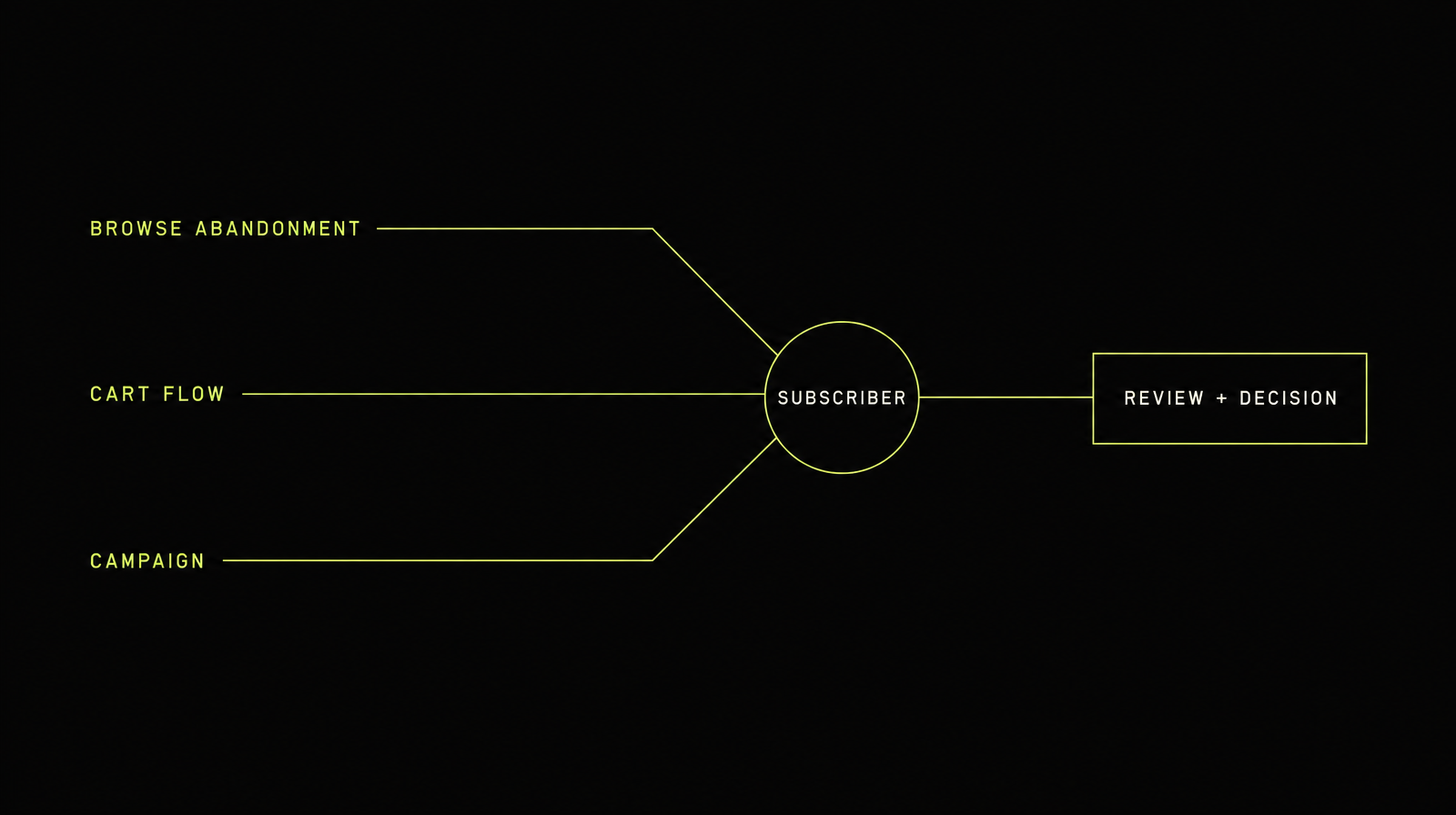
Imagine a subscriber browses a product and later adds it to their cart.
Depending on the account setup, they could become eligible for two automated journeys:
Flow A: Browse abandonment
Flow B: Added-to-cart or cart-abandonment messaging
Now imagine a scheduled campaign hits the same person during roughly the same period.
From the subscriber's side, that isn't three separate pieces of lifecycle architecture.
It's three messages from the same brand.
When two flows already compete for the same subscriber, adding another generated campaign does not resolve the conflict. It may simply become the third message.
Composer is genuinely useful here because Klaviyo currently documents the ability to audit flows for structural problems and conflicts involving overlapping messages.
But identifying that overlap still leaves several questions unanswered:
- Which flow should change?
- Should either flow be disabled at all?
- Would different timing solve it?
- Should one flow exclude people already progressing through another?
- How many subscribers are actually affected?
- Is the overlap hurting performance, or does it only look untidy on a flow map?
The underlying architecture matters more than any single message. Read: the email flows every Shopify brand needs
What Klaviyo Composer can surface vs. what you still need to decide
This is the distinction I would keep in mind when using Composer for analytical work.
This isn't a criticism of Composer.
Finding issues was never the part of an audit I considered hardest.
Deciding which issue deserves attention first, what caused it and what intervention carries the least unintended consequence is a different job.
That is why I'd rather use AI to shorten the investigation than ask it to make every lifecycle decision for me.
How to write better Klaviyo Composer prompts
Klaviyo's own prompt guidance is refreshingly straightforward.
Use natural language. Explain the goal. Add relevant account or audience context. Specify tone or constraints when needed. If the answer is too generic, add more detail and continue refining the same conversation.
That's enough for many creative tasks.
For analytical work, I'd go further.
A useful Composer prompt should define seven things.
What account, customer journey or asset are we analyzing? Give Composer the information that changes how the problem should be interpreted.
State the problem precisely. "Review my flows" is broad. "Identify flows that may send to the same subscriber within a 72-hour window" produces a much more useful investigation.
Tell the system what it must not infer. For example: use only the available account evidence; don't assume industry benchmarks; don't recommend new flows; don't treat revenue alone as proof of causation.
Specify what must be examined. For a flow-conflict review, that might include the affected flows, shared audience, likely timing and subscriber experience.
Ask for something you can review quickly. Tables are particularly useful for audits because they force findings into comparable fields instead of producing paragraphs of commentary.
Tell the AI how findings should be ranked. If subscriber exposure matters more than attributed revenue, say so. Otherwise the model may optimize for a criterion you never intended.
Require every conclusion to point back to the information supporting it. If the available evidence cannot support the conclusion, say so explicitly. In the AURORA framework, we mark that finding: UNVERIFIED.
The same thinking applies across the wider customer journey, not just one flow. Explore ecommerce lifecycle marketing
A Klaviyo Composer prompt I would actually use
Here's a shortened version of the kind of analytical prompt I'd use for a flow-conflict review:
The downloadable AURORA version goes further with complete input requirements, ranking logic, validation rules and a more detailed output structure.
Why structure a prompt this way?
Because "find problems in my flows" asks AI to define the question, choose the evidence, set the priority system and reach the conclusion.
That's a lot of hidden decision-making.
A structured prompt lets you decide the rules first.
Then Composer can do more of the heavy lifting inside those rules.
The most important instruction: show me what supports the conclusion
Large language models can sound certain even when the available evidence is incomplete.
Klaviyo itself warns that generated Composer content may not always be fully accurate and instructs users to review its output. Its prompt guidance likewise recommends checking facts when a result looks wrong.
For creative copy, fact-checking might mean verifying a product name, offer or date.
For an audit, I want something stricter.
If Composer says two flows conflict, what supports that?
- A shared trigger?
- An overlapping eligibility condition?
- Timing?
- Missing exclusions?
- Actual account configuration?
If the evidence isn't there, I don't want the prompt to quietly fill in the blank.
That one instruction makes AI analysis much easier to use responsibly because it separates what the system can see from what the system has inferred.
What to verify before acting on Composer's recommendations
When Composer flags a lifecycle issue, open Klaviyo and inspect the actual setup before changing it.
For a flow-related recommendation, I would usually verify:
The exact checks depend on the recommendation.
The principle doesn't.
Klaviyo's own documentation reinforces the same control model: Composer's audits are advisory, and the user applies the changes.
If the finding turns out to be real, the fix belongs in the flow architecture itself. See the 7 Klaviyo flows every Shopify store needs
Is Klaviyo Composer worth using?
Yes.
Composer is already useful for a much broader range of work than simple AI copywriting.
According to Klaviyo's current documentation, it can analyze performance, audit flows, campaigns, segments, forms and message content, and create campaigns, flows and segments from natural-language instructions.
And in my experience, the speed is real.
The best use case isn't necessarily handing your lifecycle strategy over to AI.
It's getting AI to perform the parts it can do quickly: finding candidates, organizing information, drafting work, checking assets and narrowing the investigation.
Then spend human attention where the consequences of the decision matter.
That balance becomes even more valuable as Composer gains deeper account context.
More context can make AI more useful.
It also makes understanding the account more important.
Download the Klaviyo AI + Judgement guide
If you want to try this method on your own account, I've put the full flow-conflict framework into a short AURORA guide.
It includes the complete prompt, what data to give the AI, the analysis instructions, output structure, decision criteria, validation rules and what I would manually inspect in Klaviyo before acting.
The article gives you the reasoning.
The guide gives you the version you can actually paste into your workflow.
Get the complete Klaviyo Composer prompt.
Klaviyo Composer FAQ
Frequently Asked Questions
What is Klaviyo Composer?
Klaviyo Composer is Klaviyo's built-in AI marketing agent. It can analyze account data, audit existing marketing assets and draft campaigns, flows and segments from natural-language instructions. Composer is currently in public beta, and users review and approve its work before anything goes live.
Is Klaviyo Composer the same as Klaviyo AI Composer?
"Klaviyo AI Composer" is a natural way people refer to Composer, but Klaviyo's official product name is Composer and its documentation describes it as an AI marketing agent.
Can Klaviyo Composer create campaigns?
Yes. Composer currently supports creating email, push, SMS and MMS campaigns from plain-language goals. It can draft content and help select or create the campaign audience, after which the marketer reviews and edits the result.
Can Klaviyo Composer build flows?
Yes. Klaviyo currently documents Composer's ability to draft new flows and the messages inside them. Composer proposes the flow structure and generates the message content, but the marketer reviews everything before setting the flow live.
Can Klaviyo Composer create segments?
Yes. You can describe the audience you want in plain language. Composer drafts a segment definition and shows the matching profile count so it can be reviewed before being saved.
Can Klaviyo Composer audit an account?
Composer can analyze account data and audit several types of Klaviyo assets. Current documentation specifically covers audits of flows, campaigns, segments, forms, templates and email/SMS content. Those findings are advisory; Composer does not apply the changes itself.
Should I trust Klaviyo Composer recommendations?
Treat Composer recommendations as evidence to review, not automatic instructions. Klaviyo itself says AI-generated output may not always be completely accurate and requires users to review its work. For strategic recommendations, verify the underlying configuration and data before making account changes.
About the author
Shuvo works in ecommerce lifecycle and retention marketing through AURORA, working primarily with Shopify and DTC brands. His recent work has focused heavily on Klaviyo accounts, including auditing, flows, segmentation and campaign strategy. AURORA is a Klaviyo Partner, Shopify Partner and Smile.io Partner.